Faraday Institution FUSE internship · IONETIC & Imperial College London
Li-Ion Battery Pack Modelling
- At a glance
- Showed that load-time imbalance grows with parallel strings and busbar-resistance spread, and that busbar open-circuit faults cause permanent imbalance
- Methods
- Simscape, equivalent-circuit cell modelling (Molicel P42A), MATLAB, current-distribution visualisation
Overview
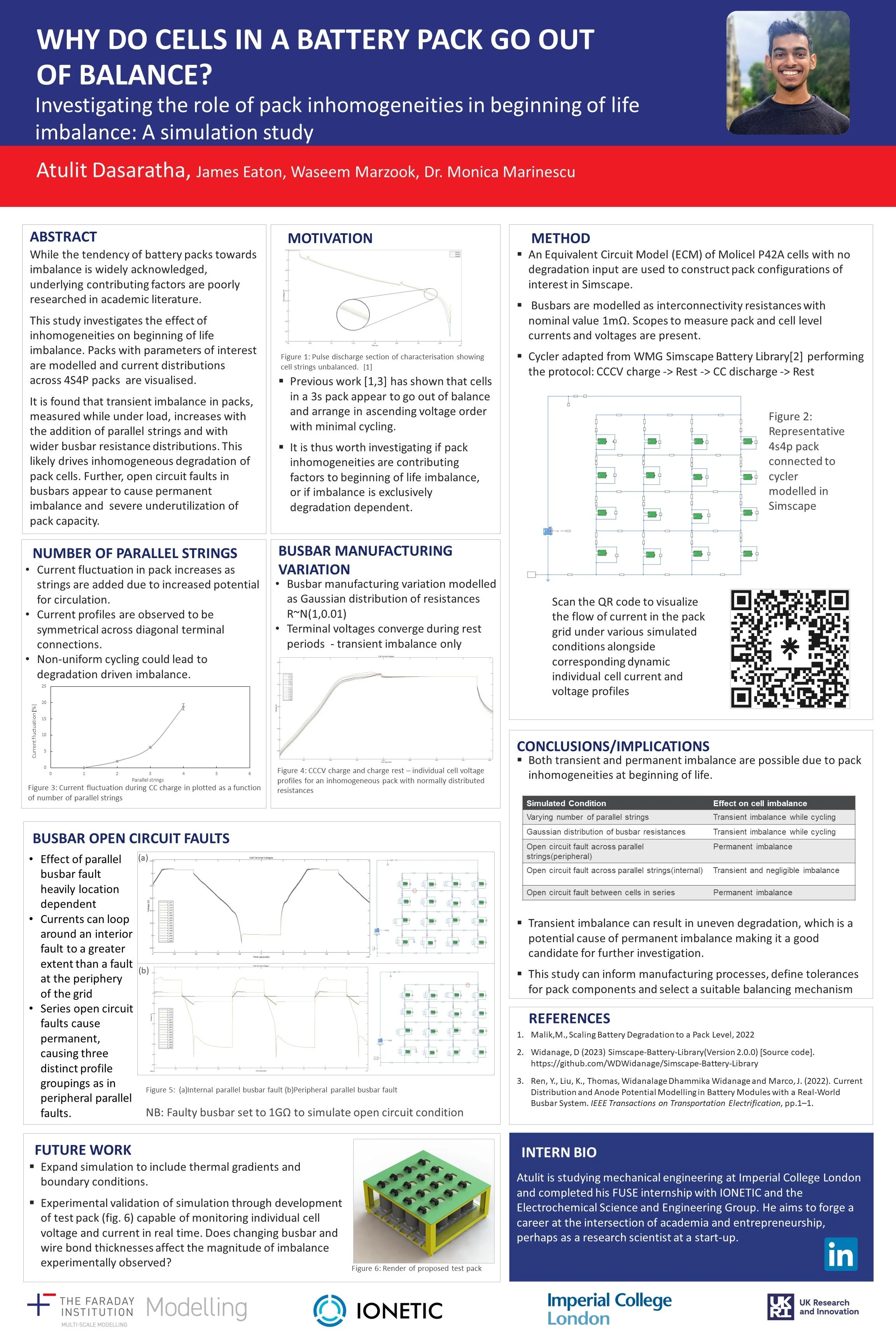
Beginning of life (BOL) cell imbalance in battery packs is a relatively poorly understood phenomenon, with literature primarily focused on the efficacy of corrective balancing algorithms. In this 8-week Faraday Institution Summer Experience (FUSE) internship with IONETIC and the ESE, Imperial College London, we aimed to gain some insight into the origins of cell imbalance in packs.
How?
Using Simscape, I developed a number of battery pack models of relevant configurations and simulated inhomogeneities based on the Equivalent Circuit Model of a Molicel P42A Li-ion cell. I developed a workflow to visualise current distributions of the simulated behaviour of battery pack models.
Result
We found that transient imbalance in packs, measured while under load, increases with the addition of parallel strings and with wider busbar resistance distributions. This likely drives inhomogeneous degradation of pack cells. Further, open circuit faults in busbars appear to cause permanent imbalance and severe underutilization of pack capacity.
A better understanding of beginning-of-life contributors to pack imbalance could potentially allow for more informed manufacturing considerations and balancing mechanism selection, and therefore better utilisation of pack capacity across its lifetime.
Poster