Mechanical design · Assistive technology
Grocery Lifting Platform
- At a glance
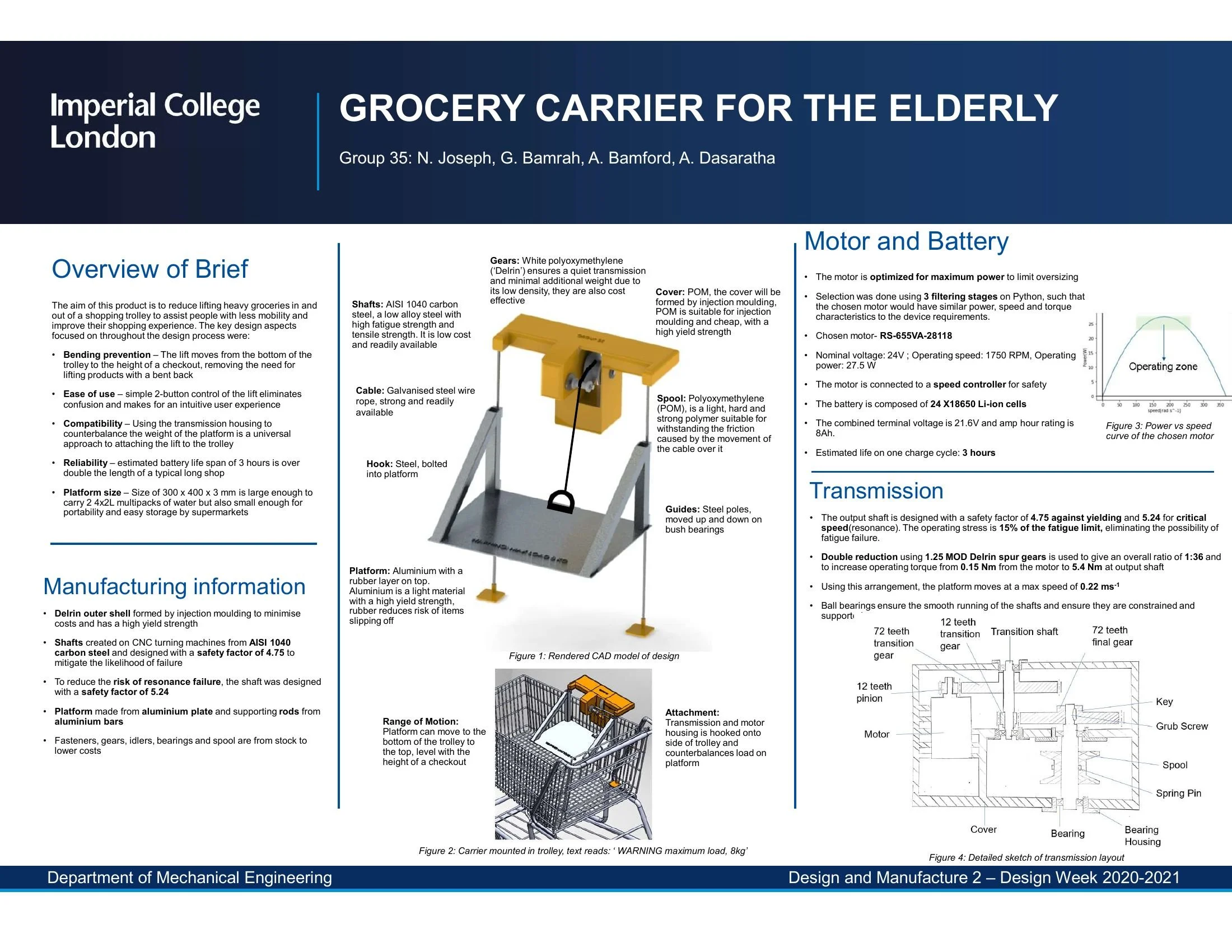
- 1:36 double-reduction spur-gear drive (0.15 → 5.4 N·m), loading under 15 s, ~3 h battery life, output shaft safety factor 4.75 in yield
- Methods
- SolidWorks design and rendering, Python motor-selection script, CES material selection, shaft stress and fatigue analysis
What?
Supermarket customers with age-related degenerative conditions often experience difficulties lifting heavy groceries in and out of their trolleys. This project aims to alleviate the problem by installing a modular assistive lifting platform on supermarket trolleys, reducing the need for customers to bend at awkward and uncomfortable angles.
How?
Important considerations include ergonomics, modularity, cost, operating time and reliability. Key design tasks were motor selection, interfacing with the trolley, material and geometry optimisation and safe casing design.
Result
A modular grocery lifting platform with a simple 2-button interface, estimated 3-hour battery life and compact platform footprint. A double reduction spur gear transmission achieves sufficient torque at the output shaft while keeping loading times under 15 seconds. Skills demonstrated: mechanical design and rendering (SolidWorks), automated motor selection (Python), material optimisation (Cambridge Engineering Selector) and component stress analysis.
Individual contributions
- Transmission design. Implemented a double reduction 1:36 transmission with 1.25 MOD Delrin spur gears to amplify torque from 0.15 Nm at the motor to 5.4 Nm at the output shaft. The output shaft is designed with a safety factor of 4.75 against yielding and 5.24 for critical speed (resonance). Operating stress is 15% of the fatigue limit, eliminating the possibility of fatigue failure.
- Automated motor selection. Wrote a Python script to sift through a large catalogue of motors and output a concise list of potential options, optimising for power and limiting oversizing. Sorting was a three-stage process shortlisting motors most closely matching the desired power, torque and speed characteristics.
- CAD rendering. Responsible for CAD modelling of the casing, transmission and final rendering. Features used include surface modelling, advanced assembly mates and configurations.
Poster